
In the previous article, we set out the framework for deciding how far Japanese inheritance tax reaches when a foreign national living in Japan inherits from a parent in their home country. This article works through the numbers in a specific case — for you, living in Japan, and for your family members overseas as well.
1. The assumed facts
The decedent and the family
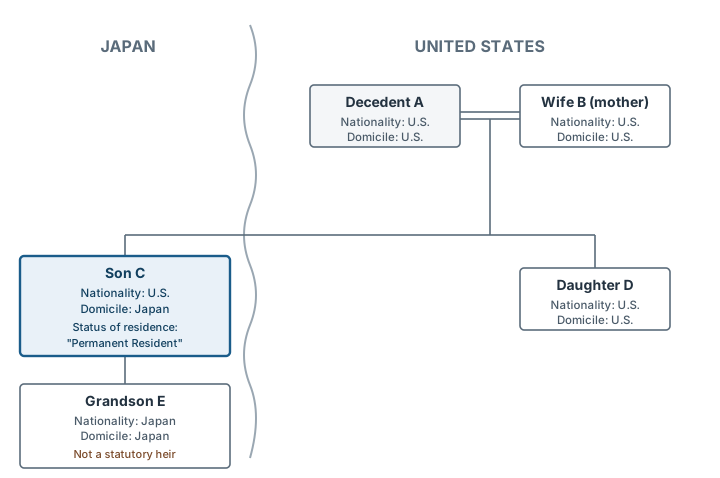
Decedent A was a U.S. national who lived in the United States all his life and never had a domicile in Japan (no domicile in Japan within the preceding 10 years — a Non-resident Decedent).
There are three statutory heirs — his wife and two children — and he also left a bequest to his grandson.
| Name | Relationship | Nationality | Domicile | Status of residence |
|---|---|---|---|---|
| B | Wife (mother) | U.S. | U.S. | — |
| C | Son | U.S. | Japan | Permanent Resident |
| D | Daughter | U.S. | U.S. | — |
| E | Grandson (Son C's child) | Japan | Japan | — |
Son C married a Japanese woman and lives in Japan holding permanent residency (the "Permanent Resident" status of residence). Grandson E is their child, born in Japan with Japanese nationality. In this example, you are in Son C's position; Wife B and Daughter D are your family members back home, and Grandson E is your own child.
Grandson E is not a statutory heir. He receives property because Decedent A left him a bequest by will.
What each person received (converted into yen)
Assets denominated in foreign currency are converted into yen, as a rule, at the telegraphic transfer buying rate (TTB) on the date the inheritance commenced. Liabilities are converted at the telegraphic transfer selling rate (TTS). Only the converted figures are shown here.
| Acquired by | Asset | Location | Amount |
|---|---|---|---|
| Wife B | Cash and deposits | U.S. | ¥80,000,000 |
| Wife B | Cash and deposits | Japan | ¥25,000,000 |
| Son C | Securities | U.S. | ¥120,000,000 |
| Son C | Life insurance proceeds | U.S. | ¥20,000,000 |
| Daughter D | Real estate | U.S. | ¥150,000,000 |
| Grandson E | Cash and deposits | Japan | ¥5,000,000 |
| Total | ¥400,000,000 |
Funeral expenses
| Borne by | Item | Location | Amount |
|---|---|---|---|
| Wife B | Funeral expenses | U.S. | ¥1,500,000 |
2. Determining the scope of taxation
The starting point is to establish, for each person, the range of property that Japanese inheritance tax reaches.
| Name | Domicile | Nationality | Category | Scope of taxation |
|---|---|---|---|---|
| Wife B | U.S. | U.S. | Limited Taxpayer | Assets in Japan only |
| Son C | Japan | U.S. | Unlimited Taxpayer | Assets in Japan + overseas assets |
| Daughter D | U.S. | U.S. | Limited Taxpayer | Assets in Japan only |
| Grandson E | Japan | Japan | Unlimited Taxpayer | Assets in Japan + overseas assets |
Why Wife B and Daughter D are Limited Taxpayers
Neither had a domicile in Japan at the time they acquired the property, and neither holds Japanese nationality. Decedent A also had no domicile in Japan at the time the inheritance commenced, and none within the preceding 10 years. Both are therefore Limited Taxpayers, and Japanese inheritance tax reaches only the assets in Japan that they acquire.
Why Son C is an Unlimited Taxpayer
Son C does not hold Japanese nationality, but he did have a domicile in Japan when he acquired the property.
The question is then whether he is a Temporary Resident. If he were, he would be a Limited Taxpayer and his overseas assets would fall outside the scope. But Temporary Resident status requires both of the following:
- Holding a status of residence under the upper column of Appendix Table 1 of the Immigration Control and Refugee Recognition Act at the time the inheritance commences
- A total period of domicile in Japan of 10 years or less within the preceding 15 years
The "Permanent Resident" status is listed in Appendix Table 2, not Appendix Table 1, so condition 1 is not satisfied. The 10-year test is never reached, however long or short his stay in Japan has been. Son C is therefore an Unlimited Taxpayer, and everything he acquires — in Japan and abroad alike — is within the scope of Japanese inheritance tax.
Grandson E
Grandson E holds Japanese nationality and has a domicile in Japan, so he is an Unlimited Taxpayer. Everything he acquires, in Japan and abroad alike, is within the scope of Japanese inheritance tax.
3. Calculating the Japanese inheritance tax
Step 1 — The taxable amount for each person
Wife B (Limited Taxpayer)
| Property acquired | Amount | Treatment |
|---|---|---|
| Cash and deposits (Japan) | ¥25,000,000 | Taxable |
| Cash and deposits (U.S.) | ¥80,000,000 | Not taxable |
| Funeral expenses | ¥1,500,000 | Not deductible |
→ Taxable amount ¥25,000,000
The same kind of asset — a bank deposit — is taxable or not depending on where the bank branch holding it is located, not on where the account holder lives. Funeral expenses are not deductible for a Limited Taxpayer.
Son C (Unlimited Taxpayer)
| Property acquired | Amount | Treatment |
|---|---|---|
| Securities (U.S.) | ¥120,000,000 | Taxable |
| Life insurance proceeds (U.S.) | ¥20,000,000 | ¥15,000,000 allowance applied; ¥5,000,000 taxable |
→ Taxable amount ¥125,000,000
Life insurance proceeds are treated as deemed inherited property, but proceeds received by a statutory heir carry a non-taxable allowance of ¥5,000,000 per statutory heir — here ¥5,000,000 × 3 = ¥15,000,000. Son C is the only heir to receive proceeds, so the whole allowance is set against his.
Daughter D (Limited Taxpayer)
| Property acquired | Amount | Treatment |
|---|---|---|
| Real estate (U.S.) | ¥150,000,000 | Not taxable |
→ Taxable amount ¥0
Grandson E (Unlimited Taxpayer)
| Property acquired | Amount | Treatment |
|---|---|---|
| Cash and deposits (Japan) | ¥5,000,000 | Taxable |
→ Taxable amount ¥5,000,000
Total taxable amount
¥25,000,000 + ¥125,000,000 + ¥0 + ¥5,000,000 = ¥155,000,000
Step 2 — The basic exclusion and the taxable estate
The basic exclusion depends on the number of statutory heirs. Daughter D has no tax to pay, but she is a statutory heir and so counts towards the exclusion. Grandson E takes under a bequest and is not a statutory heir, so he does not.
¥30,000,000 + ¥6,000,000 × 3 = ¥48,000,000
Taxable estate
¥155,000,000 − ¥48,000,000 = ¥107,000,000
Step 3 — The total inheritance tax on the estate
The taxable estate is divided according to the statutory shares, the rates are applied to each portion, and the results are added together. The statutory heirs and statutory shares under the Japanese Civil Code are used for this calculation.
| Heir | Statutory share | Portion | Rate and deduction | Tax |
|---|---|---|---|---|
| Wife B | 1/2 | ¥53,500,000 | 30% less ¥7,000,000 | ¥9,050,000 |
| Son C | 1/4 | ¥26,750,000 | 15% less ¥500,000 | ¥3,512,500 |
| Daughter D | 1/4 | ¥26,750,000 | 15% less ¥500,000 | ¥3,512,500 |
Total inheritance tax = ¥16,075,000
The figures at this stage are provisional, arrived at by dividing the estate according to the statutory shares. What each person actually bears is redistributed in Step 4, in proportion to their taxable amount.
Step 4 — Each person's computed tax
The total is apportioned in proportion to each person's taxable amount.
Wife B ¥16,075,000 × ¥25,000,000 / ¥155,000,000 = ¥2,592,741
Son C ¥16,075,000 × ¥125,000,000 / ¥155,000,000 = ¥12,963,709
Daughter D The taxable amount is ¥0
Grandson E ¥16,075,000 × ¥5,000,000 / ¥155,000,000 = ¥518,548
Step 5 — Surcharge, credits and the amount payable
Grandson E is neither a spouse nor a first-degree relative of the decedent, so his computed tax is increased by 20% (Article 18 of the Inheritance Tax Act).
¥518,548 × 20% = ¥103,709 added
Wife B is entitled to the credit for spouses (Article 19-2). Assuming the division of the estate among the heirs has been settled, her taxable amount of ¥25,000,000 is below ¥160,000,000, so the whole of her computed tax is relieved and nothing is payable.
The credit is, however, available only if a return is filed. A liability reduced to zero does not remove the filing obligation.
If U.S. estate tax has been imposed on the U.S. assets Son C acquired, the foreign tax credit (Article 20-2) allows a set portion of it to be credited against his Japanese tax. This example assumes no U.S. tax was imposed.
| Name | Computed tax | Surcharge / credits | Amount payable |
|---|---|---|---|
| Wife B | ¥2,592,741 | Credit for spouses −¥2,592,741 | ¥0 |
| Son C | ¥12,963,709 | — | ¥12,963,700 (rounded down to the nearest ¥100) |
| Daughter D | ¥0 | — | ¥0 (no return required) |
| Grandson E | ¥518,548 | 20% surcharge +¥103,709 | ¥622,200 (rounded down to the nearest ¥100) |
4. What this example shows
Daughter D receives ¥150,000,000 of U.S. real estate and pays nothing. Son C receives ¥140,000,000 and pays close to ¥13,000,000. Domicile and status of residence are what separate them.
A few points worth taking away:
An heir who owes nothing is still counted as a statutory heir. Daughter D pays not a single yen of Japanese inheritance tax, yet she enters both the basic exclusion (¥6,000,000 × 3) and the total-tax calculation (a one-quarter statutory share). Getting this wrong throws off the whole computation.
A grandchild is taxed more heavily than a child. Grandson E is neither a spouse nor a first-degree relative of the decedent, so his tax carries a 20% surcharge.
With funeral expenses, who pays decides the outcome. Funerals are often held abroad and paid for by a family member living abroad. Where that person is a Limited Taxpayer, the cost is not taken into account at all. Where you, as an Unlimited Taxpayer, bear it, the expense is deductible even though the funeral took place overseas (Article 13(1)(ii)).
A tax agent may have to be appointed. Wife B has no domicile in Japan and must nevertheless file a return in order to claim the credit for spouses. In that case a nōzei kanrinin (tax agent) must be appointed and notified to the tax office.
The filing deadline is 10 months from the day after you become aware that the inheritance has commenced. Valuation material for overseas assets and documents from the local succession process take considerable time to obtain. It is worth starting early.
In closing
Where an estate crosses borders, the range of property taxed and the liabilities that may be deducted differ from one person to the next, even though a single decedent is involved. Who acquires what, where that property sits, and whether the recipient is a statutory heir all move the final figure substantially.
Son C held the "Permanent Resident" status, so he was an Unlimited Taxpayer whatever the length of his stay, and Japanese inheritance tax reached his U.S. securities and insurance proceeds. Had he instead held, say, the Engineer/Specialist in Humanities/International Services status and lived in Japan for 10 years or less, he would have been a Temporary Resident and his overseas assets would have fallen outside the scope. The same family, the same estate, and a very different figure. The next article works through the calculation where you are a Temporary Resident.
Drawing on many years of international tax practice, our office assists with inheritance tax returns involving overseas assets, taxpayer-category determinations, and the availability of the foreign tax credit. The initial consultation is complimentary. Please feel free to get in touch.
Based on laws and regulations in force as of April 1, 2026. This article is general information, not advice.. Tax outcomes depend on your specific facts and the rules may change. Please consult a certified tax accountant (zeirishi) regarding your individual circumstances.
Supervised by Takuya Oishi, Certified Public Tax Accountant (Zeirishi) Registration No. 151174, Tokyo Certified Public Tax Accountants' Association (Azabu Branch)